

Filters

Stop Building GTM in Slides. Start Building It Like a System.
Thanks for being one of over 178,000 forward-thinking GTM Leaders who subscribe to this weekly research note.
This week’s research note includes:
GTM Research: Stop Building GTM in Slides. Start Building It Like a System.
GTM OS Certified Partner Spotlight: Cate Hollowitsch
Today! How to build a fractional business in 2026
Research: Stop Building GTM in Slides. Start Building It Like a System.
Most teams build GTM plans backward.
They start with tactics. They copy motions from competitors. They guess. Then they complain when pipeline feels slow or random.
A real GTM playbook starts long before you pick your tactics. It starts with two decisions.
You complete your Market Investment Map across new business and expansion.
If you skip these, the motions will wobble no matter how good your team is.
Once you lock your ICP and Market Investment Map, the rest becomes a structured exercise. You build the playbook segment by segment. You use the eight pillars of the GTM OS to make sure you do not leave gaps.
We usually do this on a spreadsheet, but it’s small and hard to see, so we’re sharing all the steps here and then an example.
Here’s what our spreadsheet looks like, BTW:
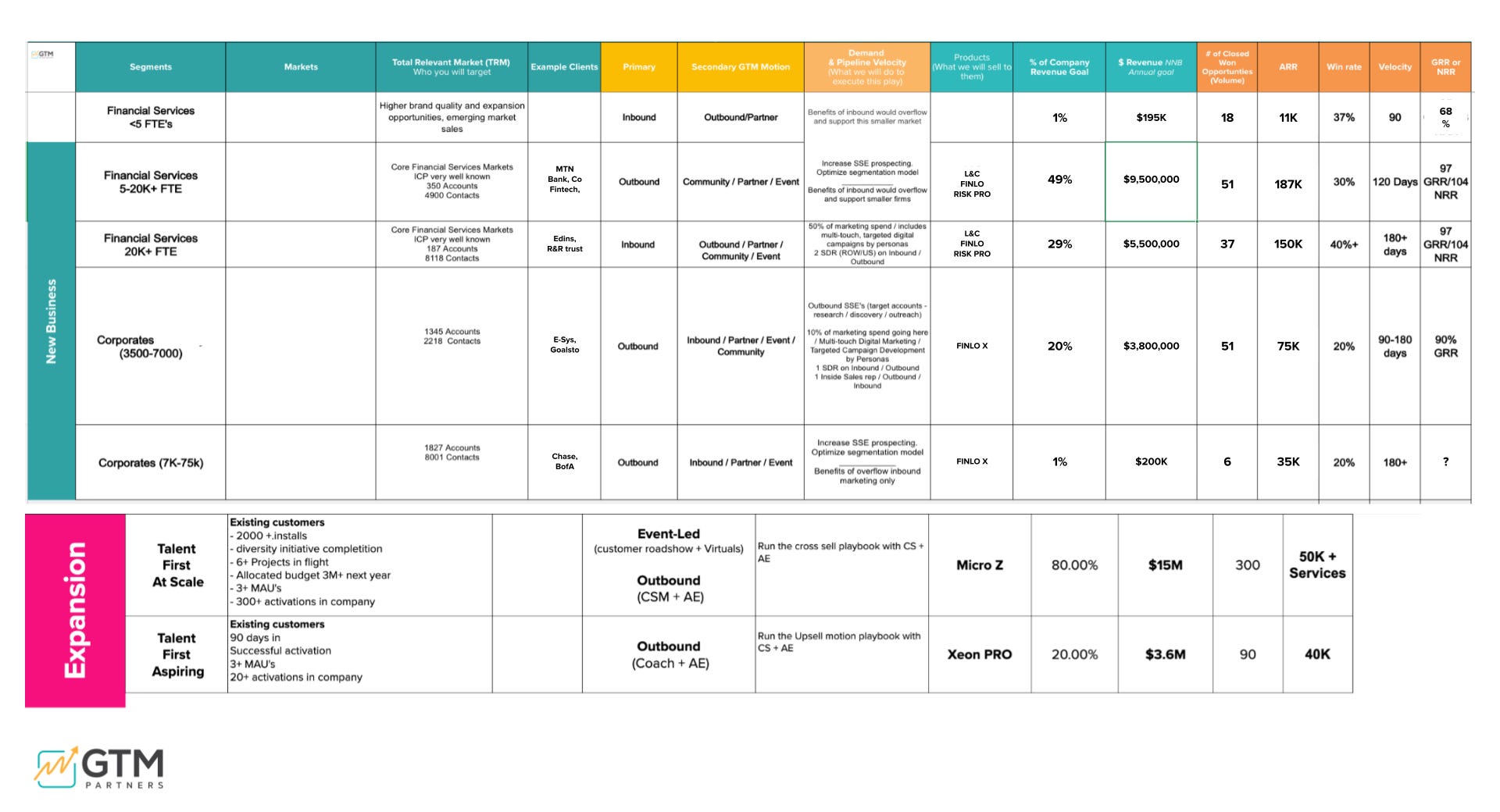
Too hard to read! So here’s what all those little cells say at the top.
1. Name the segment and the target accounts
Spell out who you will pursue. Show example clients so the team can picture real companies. Draw a clear line around who is in and who is out.
2. Define what you will sell
List the products or packages that match the pain in that segment. If a product does not solve a painful problem, remove it from the plan.
3. Set revenue expectations
Show the dollar goal and the percentage of total revenue you expect this segment to drive. Your team needs to see the mix. They also need to see what success looks like in relative terms.
4. Work backward from closed won
Calculate how many closed won deals you need. Use your actual conversion rates, not wishful thinking.
5. Set churn and LTV assumptions
Every motion depends on protecting the base. State your expected churn and the lifetime value target for this segment. This removes emotional debate later.
6. Pick the GTM motions
Choose the motions that match buyer behavior. Inbound. Outbound. Partner. Product led. Event led. Community. You need discipline here. Pick motions that align with how these buyers actually buy.
7. Identify personas and buying committees
List the roles you will engage. Identify blockers, influencers, and the person who can kill the deal.
8. Build the messaging
Create a single point of view for this segment. Make it sharp. Make it painful. Make it clear why you win.
9. Document the plays and programs
Spell out the actions. Do not rely on generic sequences. Outline the specific offers, triggers, and steps.
10. Name the GTM owners and resources
Assign people to each play. List the teams and skills required. Accountability only works when the names are visible.
11. Define the post sale plays
Retention, expansion, onboarding. State the moments that matter and what must happen at each moment.
12. Map the infrastructure
List the systems, tools, data, and integrations you need to support the motions. If the data is unreliable, the motion will fail.
13. Map the process requirements
Document the new processes the team must follow. Be clear about SLAs, handoffs, and definitions.
14. State your assumptions and risks
List the conditions that must stay true for this plan to work. List the risks that could break the model. Mature GTM teams tell the truth about risk.
When you build a motions playbook this way, your GTM stops living in slide decks. It becomes an operating blueprint. It tells your team who to target, what to sell, how to win, and what will break if they drift.
You’ll notice that all of these things map to the GTM Operating System.
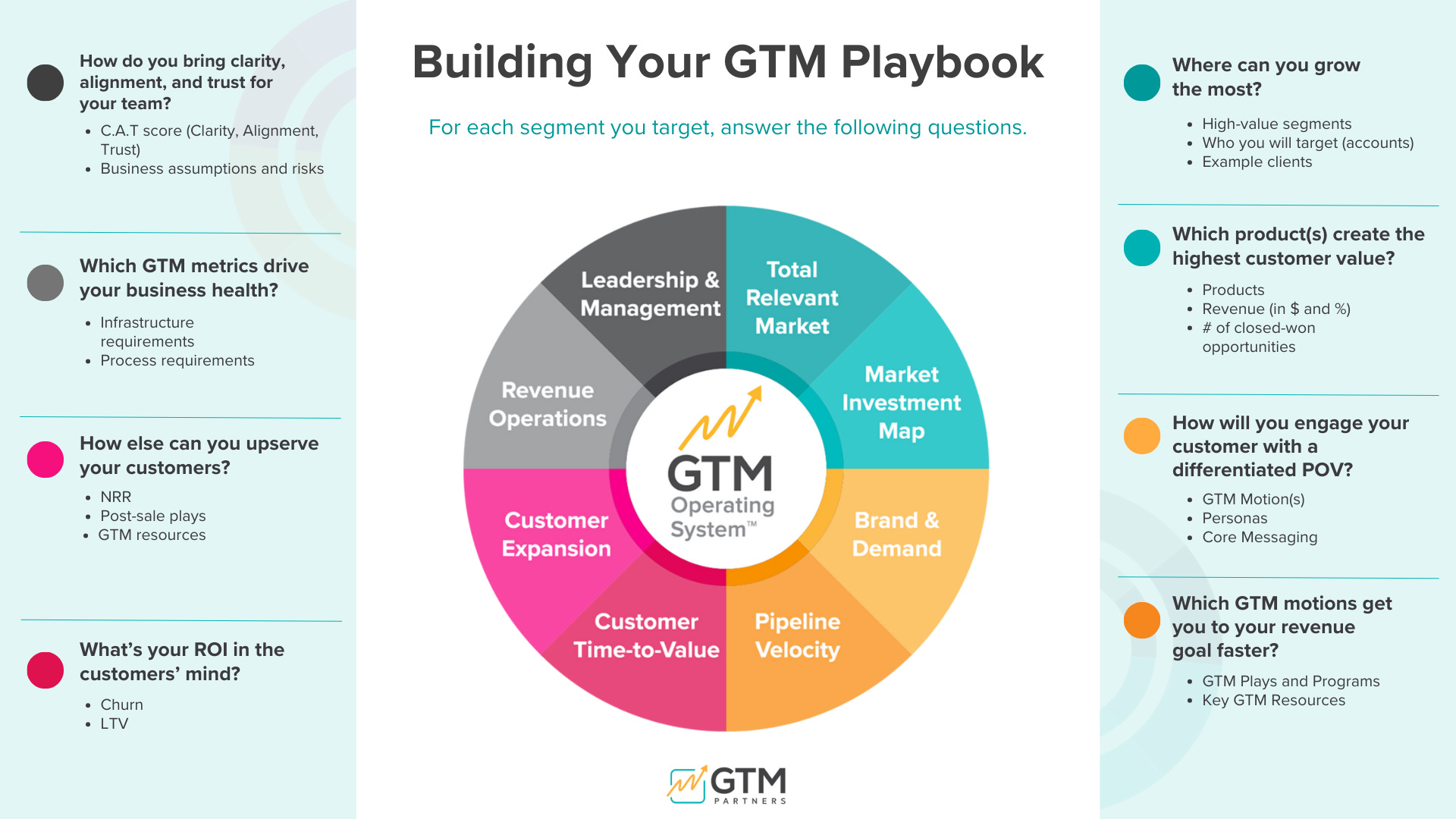
Example Segment: Mid-market Expansion, $100M ARR B2B SaaS Company
Here is a concrete example. It shows how a $100M B2B SaaS company might structure one segment of its GTM Motions Playbook.
This company sells a workflow automation platform to operations teams. They have three products. Core Platform, Analytics Add On, and an AI Assistant.
They already have solid penetration in SMB and mid-market new business.
Their biggest 2026 revenue upside sits in expansion.
Below is one segment of their motions playbook.
Segment: Mid-market Expansion Customers ($50K to $150K ARR)
These customers use the core platform but have not adopted Analytics or the AI Assistant.
Target Accounts
• Existing customers with at least 12 months of usage
• Healthy adoption of core workflows
• Low support ticket volume
• Example accounts: Fulton Energy, Northway Logistics, Brava Retail Group
What We Will Sell
• Analytics Add On
• AI Assistant for three core workflows
• Bundle priced at $30K incremental ARR
Revenue Expectations
• Segment revenue target: $12M incremental ARR
• Represents 12 percent of total 2026 revenue
• Requires converting 400 of the 1,800 eligible accounts
Closed Won Math
• Target 400 expansions
• Current expansion close rate: 22%
• Required pipeline: roughly 1,800 opportunities
• Each CSM must source 6 qualified expansion opps per month
Churn and LTV Assumptions
• Expected churn: under 3% for this group
• Expansion LTV target: $350K
Chosen Motions
• Outbound CSM led expansion sequence
• Event led motion anchored on quarterly customer roadshows
• Partner influence motion with SI partners who configure Analytics
Personas and Buying Committees
• Director of Operations (economic buyer)
• Ops Manager who owns workflow setup (technical buyer)
• CFO who approves spend above $25K
• IT is not a blocker but must review data usage
Messaging
• Pain: visibility gaps in cross functional workflows
• POV: You cannot scale operations without shared analytics
• Why us: we already run the core workflows, so our analytics pay off faster
Plays and Programs
• Workflow Value Review, a 30 minute session with quantified ROI
• Roadshow workshop series in six core cities
• AI Assistant pilot program for 90 days
GTM Owners and Resources
• CSM team leads outbound expansion
• SE team supports technical evaluations
• PMM owns messaging and collateral
• RevOps tracks conversion and pipeline health
Post Sale Plays
• Analytics onboarding workflow completed in 30 days
• AI Assistant behavior scoring report shared at 60 days
• Renewal call at 90 days tied to realized savings
Infrastructure Requirements
• Clean product usage data in the CRM
• Expansion opportunity fields added
• CSM outbound sequences built in engagement platform
• Partner attribution tracking
Process Requirements
• CSM must log all expansion opps within 48 hours
• SE must attach configured workflow templates to each opp
• PMM must publish updated ROI calculator quarterly
Assumptions and Risks
• Analytics must integrate with two new ERPs by Q2
• CSM capacity must increase by 20 percent
• If AI Assistant accuracy slips under 85 percent, win rates will fall
The Real Value of a GTM Playbook
This may feel like a lot, but it is the cost of a predictable GTM engine.
When you do this work segment by segment, the noise drops. The team stops arguing about tactics. You stop guessing. You know who you are targeting, what you expect to earn, and how you plan to get there. A motions playbook gives you clarity. It also gives you a way to hold the entire GTM team accountable to the same model.
Need Help Building Your Playbook?
If you want a GTM motions playbook that holds up under pressure, Sangram and Bryan are ready to walk you through it.
They can help you build it step by step or point you to a certified fractional leader in the GTM Partners network who does this work every day.
Do not guess. Get guidance from people who see hundreds of GTM systems a year and know what good looks like.
Certified Partner Spotlight: Cate Hollowitsch
Turning Vision into Scalable Growth
When growth stalls or strategy execution fractures across teams, Cate Hollowitsch brings the clarity, structure, and leadership to get momentum back.
As founder of Relevents Group and a seasoned GTM executive and board director, Cate partners with founder-led and PE-backed companies to align strategy, optimize resources, and unlock scalable growth. Her proprietary frameworks—True North OS™, Brand Blueprint™, and Culture Canvas™—are built to move companies from reactive execution to enterprise-wide alignment and long-term advantage.
Where Relevents Group Delivers Impact:
Uncovering and activating untapped growth potential
Creating GTM strategies that align brand, culture, and execution
Amplifying the ROI of existing teams and budgets
Helping CEOs shift from short-term fixes to sustainable scale
If your company’s vision is clear but traction is inconsistent, Cate helps bridge the gap between strategy and results—with systems that scale.
Learn more: Cate Hollowitsch/Relevents Group Partner Page →
If you’d like to be a certified GTM Partner like Cate and more than 70 others, we’d love to talk to you about how to make that happen.
Last EVENT of the Year: Today!!
Fractional Leaders, This One Is Worth Your Time
Sarah Allen Short, a GTM OS Certified Partner, is hosting a live session on December 15 where she will share her first full year as a fractional, including real numbers, wins, mistakes, and what the work actually looks like day to day.
She did this once before and over 300 people signed up, so she offered to do it again.
She made more this year than she did as a CMO and is opening the entire playbook with no pitch attached.
If you are fractional or even fractional curious, this is a rare chance to cut months off your learning curve.
(this is LIVE only and may not be recorded due to lot of personal info)
Love,
Sangram and Bryan
p.s. Access GTM University | Hire GTM OS Certified Partners | Read Fractional Friday
Thanks for reading GTMonday by GTM Partners!
Subscribe for free to receive new posts and support our research work.