

Filters

A new diagnostic for 2026: Is your GTM AI failing you?
Thanks for being one of over 178,000 forward-thinking GTM Leaders who subscribe to this weekly research note.
This week’s research note includes:
GTM Research: A new diagnostic: Is your GTM AI failing you?
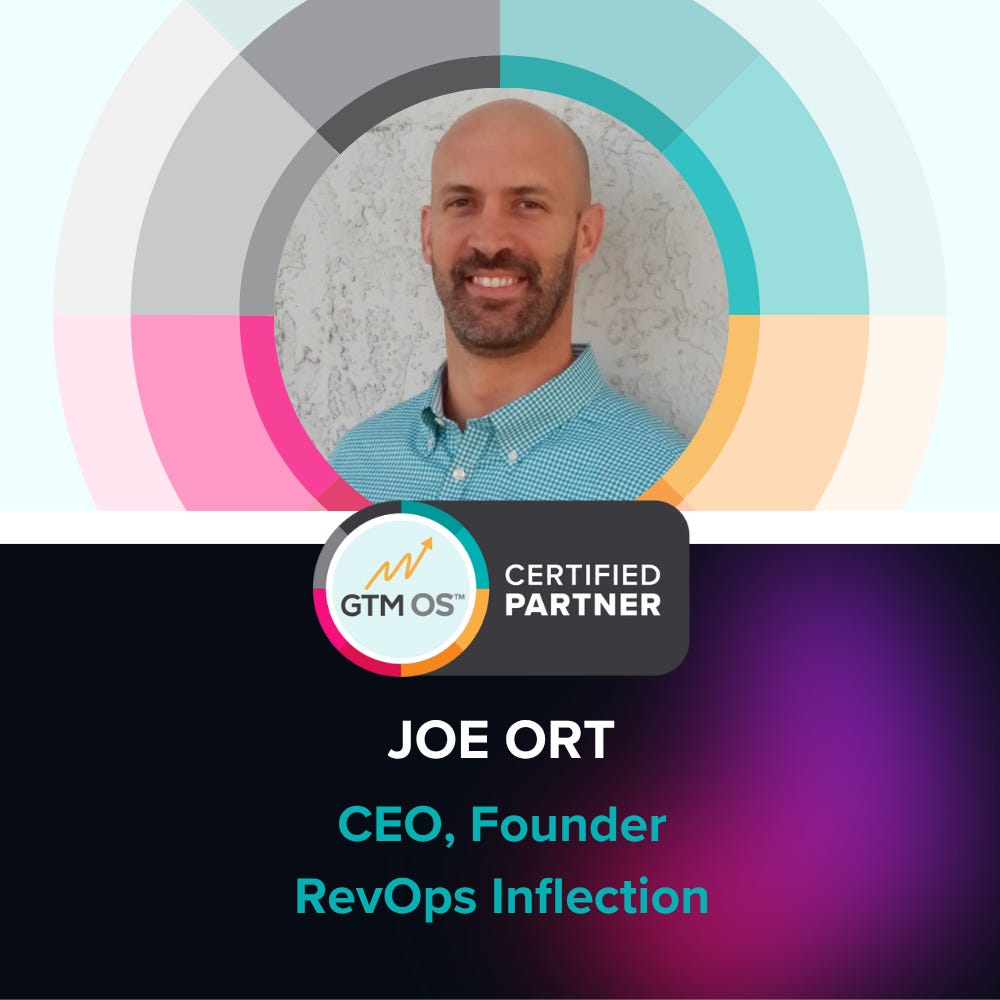
GTM OS Certified Partner Spotlight: Joe Ort
Upcoming Events and Access
Research: A new diagnostic: Is your GTM AI failing you?
Every GTM team is asking the same question heading into 2026.
What AI should we be using?
Most teams answer it backwards. They start with tools. They skip stage. Then they wonder why nothing compounds.
AI does not create leverage on its own. It accelerates whatever GTM system you already have. If that system is unclear, AI scales the confusion.
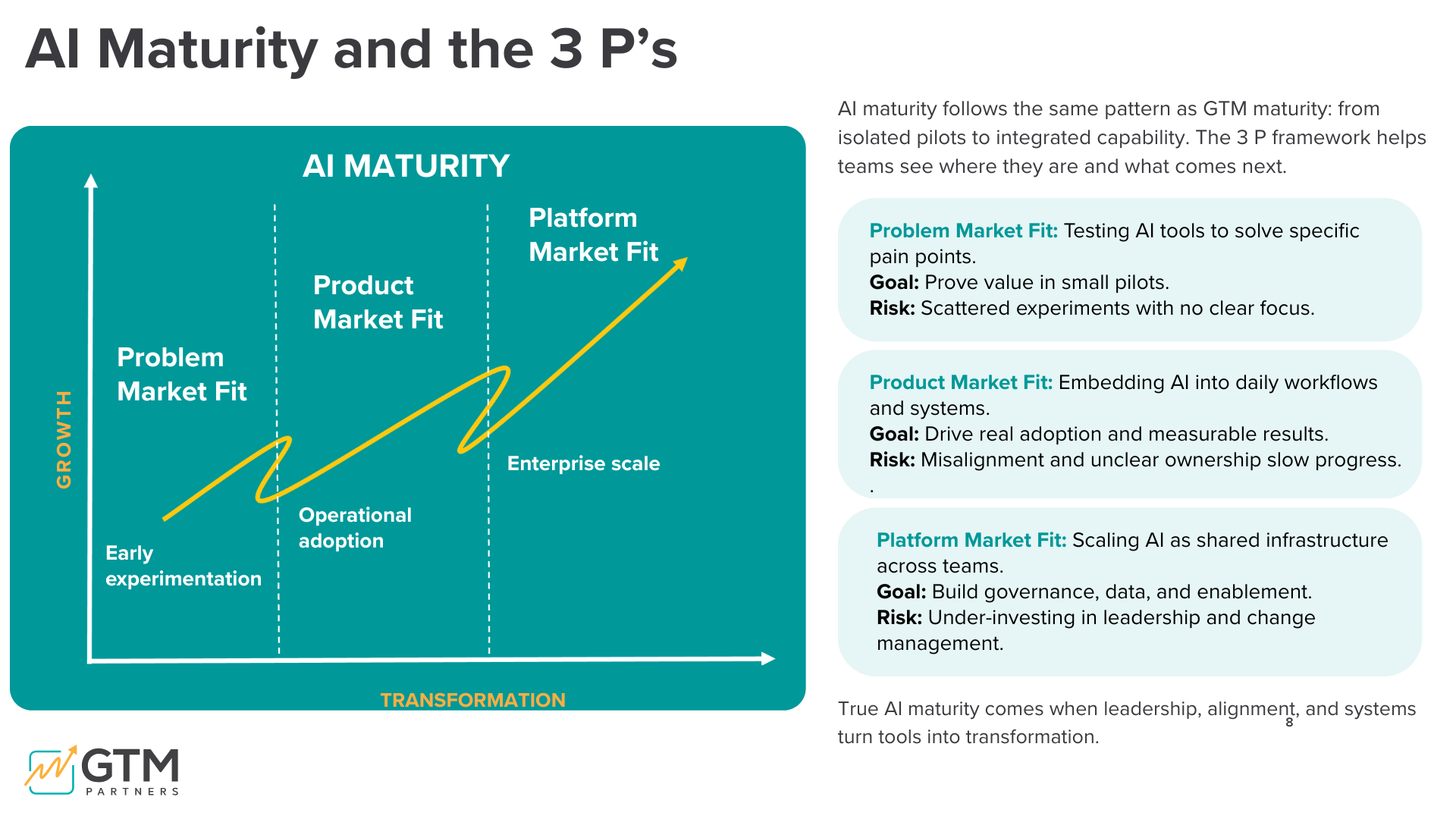
This is exactly the failure pattern the 3 Ps framework was built to prevent. It exists to help teams change strategy at the right moment, not layer complexity on top of the wrong one.
Why AI fails so often in GTM
The data is blunt. AI is not yet delivering on its promise:
MIT Sloan research published in 2025 found that roughly 95% of generative AI pilots show no measurable P&L impact, with only about 5% driving material revenue acceleration
Multiple industry studies, including work summarized by Gartner and McKinsey, show 70-80 % of AI initiatives stall before production or fail to scale
Gartner forecasts that over 40% of agentic AI projects will be abandoned by 2027 due to unclear outcomes and poor integration
Data quality, unclear ownership, and misaligned processes account for over 80% of AI failures, not model performance
Most AI initiatives do not fail because the technology is weak.
They fail because they are deployed without strategy or clarity on business stage.
AI makes things faster, and that can work for you or against you.
If your GTM strategy is mismatched to your stage, AI accelerates the stall. You scale noise. You automate confusion. You add tools instead of clarity. On the other hand, if you’re aligned, AI accelerates success.
The companies that win in 2026 will not be the ones with the most AI. They will be the ones with the best alignment between business stage, GTM strategy, and AI usage.
A new diagnostic tool : Is your AI failing you?
We developed a new diagnostic tool to help you understand if your GTM-related AI is failing you. Count your “yes” answers.
Sales and pipeline reality
Has sales activity increased without a corresponding increase in closed revenue? yes/no
Has pipeline grown while win rates stayed flat or declined? yes/no
Are reps spending less time selling and more time managing tools, alerts, or dashboards? yes/no
Do deals still stall for unclear reasons despite more “insight” than before? yes/no
Decision velocity
Do you have more dashboards than last year but slower decisions? yes/no
Are forecast calls longer without becoming clearer? yes/no
Do teams argue over whose data is right instead of what action to take? yes/no
Do leaders ask for more reports instead of making calls? yes/no
Alignment before automation
Did you roll out AI or automation before locking ICP, buyer, and core message? yes/no
Are different teams using AI for different goals without a shared definition of success? yes/no
Did tooling decisions happen faster than process decisions? yes/no
Can you clearly explain what human judgment AI is supposed to replace or augment? yes/no
Signal versus noise
Has AI increased the volume of leads, emails, or touchpoints without improving conversion? yes/no
Are reps overwhelmed by signals they do not trust? yes/no
Do you chase accounts that look active but do not buy? yes/no
Has personalization become superficial instead of sharper? yes/no
Customer impact
Have prospects complained about irrelevant or excessive outreach? yes/no
Have previously good ICPs gone cold after automation scaled? yes/no
Do customers experience inconsistent messaging across sales, marketing, and CS? yes/no
Does AI show up in the customer journey before clarity does? yes/no
Internal consequences
Do teams blame tools instead of GTM decisions? yes/no
Has AI become a justification for doing more instead of doing less? yes/no
Are you adding headcount or spend to “fix” problems AI was supposed to solve? yes/no
Scoring your answers
Count up the number of questions you answered “yes” to.
0 to 3
Your AI use is likely aligned with your stage. Stay disciplined. Do not expand scope yet.
4 to 8
You have early signs of stage mismatch. AI is starting to create drag. Pause expansion and reassess where you are in the 3 Ps.
9 to 14
AI is actively working against your GTM. You are scaling activity without leverage. Expect stalled growth and rising frustration.
15+
AI is not your problem. Lack of stage clarity is. Until that is fixed, more tooling will make things worse.
So how do we fix it?
If the diagnostic above was a bit eye opening, here is some guidance on how to think about AI at every stage of the 3 P’s.
Problem Market Fit
If your win rate is under 20%, AI should be listening, not selling
At Problem Market Fit, your job is truth.
You are still answering basic questions:
Is the problem real?
Who feels it most?
Why do they care enough to act?
The numbers tell you when you are here:
Fewer than 10 closed-won deals per quarter per segment
Win rates below 15-20%
Sales cycles that vary widely by persona
Objections that change deal to deal
If this describes you, scaling outbound or automating SDR activity is a mistake.
The only GTM AI that makes sense at this stage:
Call and interview analysis
Objection clustering
ICP pattern detection across qualitative data
Message testing and synthesis, not content volume
If AI is talking to customers before you understand them, you are avoiding the work.
Product Market Fit
Product Market Fit is not a feeling. It is math.
Signals you are actually here:
Win rates stabilize above 20 to 30 percent
One buyer persona dominates revenue
One core use case closes repeatedly
Sales cycle variance tightens
Only now does speed start to matter.
Where GTM AI earns leverage at this stage:
Speed-to-lead that moves response time from hours to minutes
Deal inspection that flags stalled or high-risk opportunities
Sales assist that reinforces a single message
Funnel analysis that exposes consistent drop-off points
Here is the uncomfortable truth:
If you’re using AI to help you say more things to more people, you are still in the wrong stage.
Platform Market Fit
Most companies believe they are here. Very few actually are.
You are not in Platform Market Fit unless:
>30% or more of new revenue comes from existing customers
You sell > two products to the same account base
Expansion motions are designed, not accidental
Sales, marketing, and CS share account definitions
Only at this stage does GTM AI become a coordination layer.
Where AI actually works at Platform Market Fit:
Expansion and churn prediction tied to usage data
Account prioritization across inbound, outbound, and CS signals
Territory and capacity modeling
Pricing and packaging analysis
Multi-product revenue orchestration
If expansion is not a board-level metric, platform AI creates noise, not leverage.
How to approach AI in 2026
Start with one question.
Which stage are we actually in?
If you want to build the judgment to answer that yourself, GTM University teaches how to diagnose stage, align GTM strategy, and make disciplined investment decisions.
If you want experienced operators to help you align your strategy, team, and AI stack before spend compounds in the wrong direction, working with GTM Partners puts stage clarity at the center of execution.
2026 will reward focus.
AI will punish shortcuts.
Certified Partner Spotlight: Joe Ort
Optimizing RevOps to Unlock Scalable SaaS Growth
When B2B SaaS companies hit the $10M–$100M ARR inflection point, misalignment across the revenue engine can quietly erode growth. Joe Ort, founder of RevOps Inflection, helps companies fix that—fast.
With 15+ years of experience in private equity-backed environments and deep roots in SiriusDecisions’ frameworks, Joe brings structure, clarity, and operational rigor to every engagement. He specializes in aligning strategy, systems, and data across marketing, sales, and customer success to ensure revenue operations isn’t just a function—it’s a growth lever.
Where RevOps Inflection Delivers Impact:
Diagnosing GTM gaps and inefficiencies across functions
Streamlining processes and data flows for scale
Building aligned systems across the entire revenue engine
Maximizing ROI on GTM investments through measurable impact
Joe brings a practical, systems-driven approach to Revenue Operations—helping companies unlock growth they already have inside.
Learn more: Joe Ort Partner Page →
If you’d like to be a certified GTM Partner like Joe and more than 70 others, we’d love to talk to you about how to make that happen.
GTM Events
A list of upcoming events of interest to GTM professionals
January 9, 2026: Clearing Space for 2026 (for GTM Leaders) (Led by GTM Certified Partner Sarah Allen-Short)
January 12, 2026: How to Break Into Private Equity as a Fractional or Interim CMO / GTM Leader (led by GTM Certified Partner Alan Gonsenhauser)
January 23, 2026: Creating Boundaries for GTM Leaders (led by certified partner Sarah Allen-Short)
February 9, 2026: How to Break Into Startups as a Fractional CRO or GTM Leader (led by GTM Certified Partner Marc Sabatini)
Love,
Sangram and Bryan
p.s. Access GTM University | Hire GTM OS Certified Partners | Read Fractional Friday
Thanks for reading GTMonday by GTM Partners!
Subscribe for free to receive new posts and support our research work.