

Filters

New Research: Why Most GTM Plans Fail by Q2 (And How To Fix It)
Thanks for being one of over 178,000 forward-thinking GTM Leaders who subscribe to this weekly research note.
This week’s research note includes:
GTM Research: Why Most GTM Plans Fail by Q2
GTM OS Certified Partner Spotlight: Maria Scheifler, MKT Velocity
Upcoming Events and Access
Research: Most GTM plans fail by Q2.
Not because the team did not execute. Because the plan you approved in Q4 no longer matches the business you are actually running by spring.
Maybe (probably):
Headcount changed.
Pipeline mix shifted.
One segment started wobbling.
Another over-performed.
Sales and marketing are now solving different problems.
The macro-economic picture shifted.
None of these things show up in an annual plan. Pretending an annual plan can cover all contingencies is how GTM drifts.
The mistake most CEOs make is treating GTM planning as an annual event instead of an operating discipline.
Once a year feels responsible. It is also too slow for how fast complexity shows up.
Here is the six step GTM planning process we run every quarter to keep focus, alignment, and investment decisions grounded in reality.
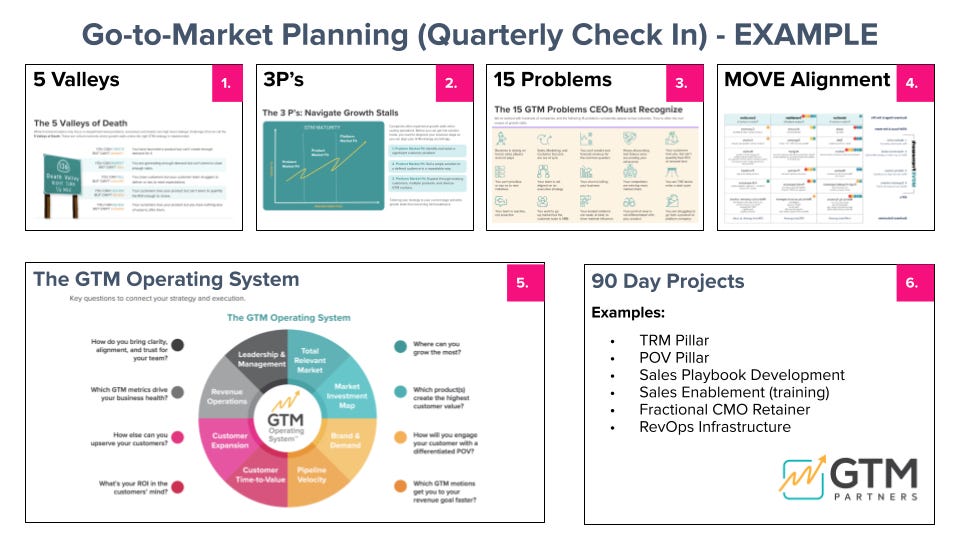
Step 1. Identify your GTM valley of death.
Every single company goes through one or more of the 5 Valleys of GTM Death. Some go through all of them. Most encounter them again and again whenever they launch a new product, service, or motion.
You do not have the resources or attention to fix everything at once. Trying to do so is how teams burn cycles without moving outcomes.
Why revisit the Valleys every quarter?
Because you don’t “graduate” from them forever.
A company that fixed its marketing gap last year may struggle with delivery this year.
A product that renews well may stall on expansion until you build new value.
A scaling team may solve one valley, only to slip back into another as complexity grows.
By asking which valley are we in right now? each quarter, leaders avoid false confidence and catch issues before they compound.
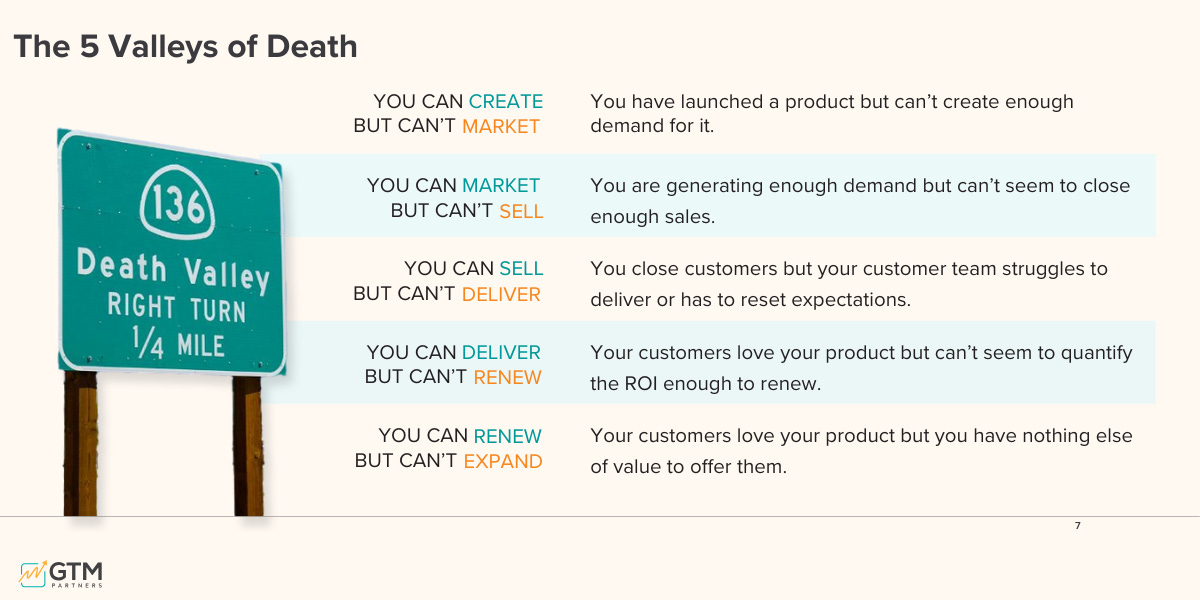
As CEO, your job is to pick the one that is actively costing you growth right now and say no to the rest for the next 90 days. That decision alone usually creates more clarity than any dashboard.
Once you solve it, you’ll be in a new valley and you can re-direct resources accordingly.
Step 2. Know your stage.
Most GTM plans fail because the company is running the wrong playbook for its stage.
There are three stages:
Problem-Market Fit: You are still proving who you serve and why they buy.
Product-Market Fit: You have repeatability and need to scale demand and sales execution.
Platform-Market Fit: You are expanding across products, segments, and motions.
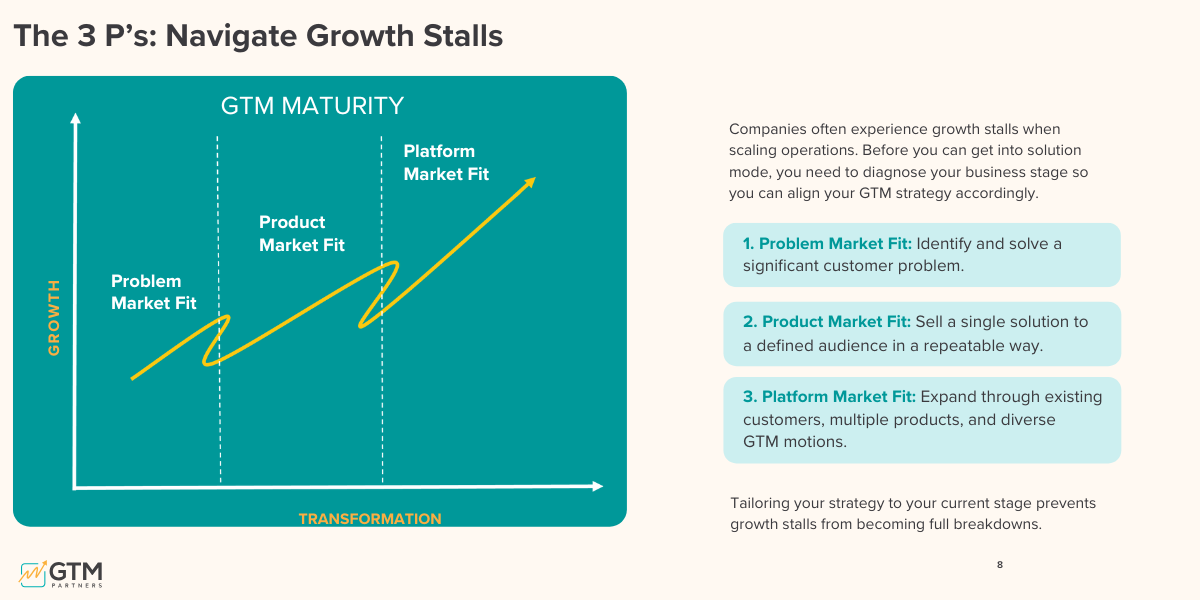
Each stage requires different GTM decisions. Different investments. Different expectations.
We often see companies running platform motions while still operating like they are in problem stage. More tools. More campaigns. More complexity. Very little momentum.
If your exec team cannot clearly articulate your stage, you are already paying for that confusion in wasted effort.
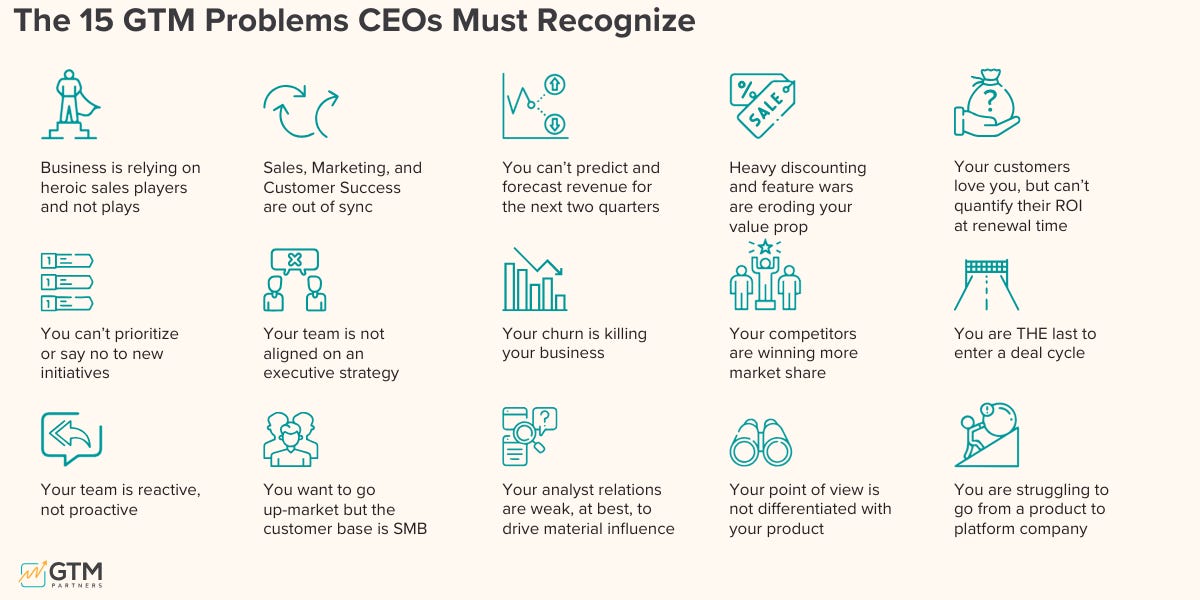
Step 3. Name your top three GTM problems.
There are only so many ways GTM breaks. We see the same set of problems across companies of all sizes.
The failure mode is not lack of insight. It is lack of focus.
Most leadership teams can name seven or ten problems without blinking. That list feels honest. It is also unusable.
Pick three.
Not forever. For the next 90 days.
If everything is urgent, nothing is fixable.
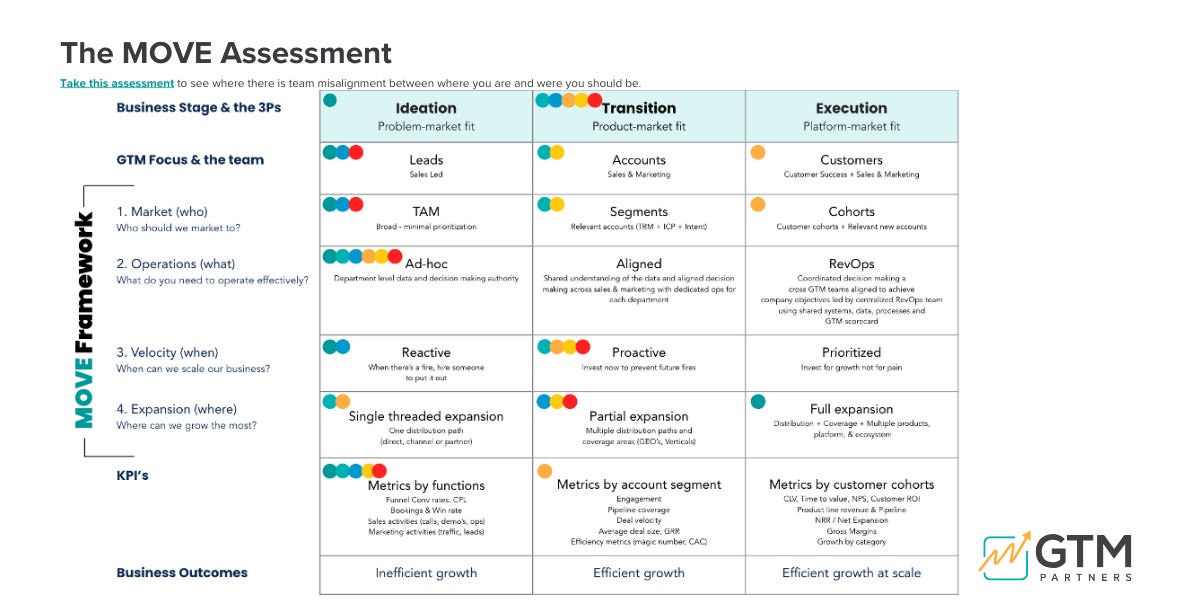
Step 4. Run the MOVE conversation with your exec team.
This is where planning stops being polite and starts getting real (shout out to the Gen-Xers who get the reference!).
Marketing usually sees the problem one way.
Sales sees it another.
Customer success brings a third perspective.
MOVE forces those differences into the open. Not to resolve everything, but to make misalignment visible.
If your exec team agrees too quickly, you are probably skipping the real issues. Productive tension is a signal that you are finally talking about the same system instead of defending functions.
Alignment does not come from consensus. It comes from shared understanding of tradeoffs.
Step 5. Answer the eight GTM OS questions.
This is the moment where strategy becomes explicit.
Who you serve.
How you win.
Where you invest.
What you measure.
How teams operate together.
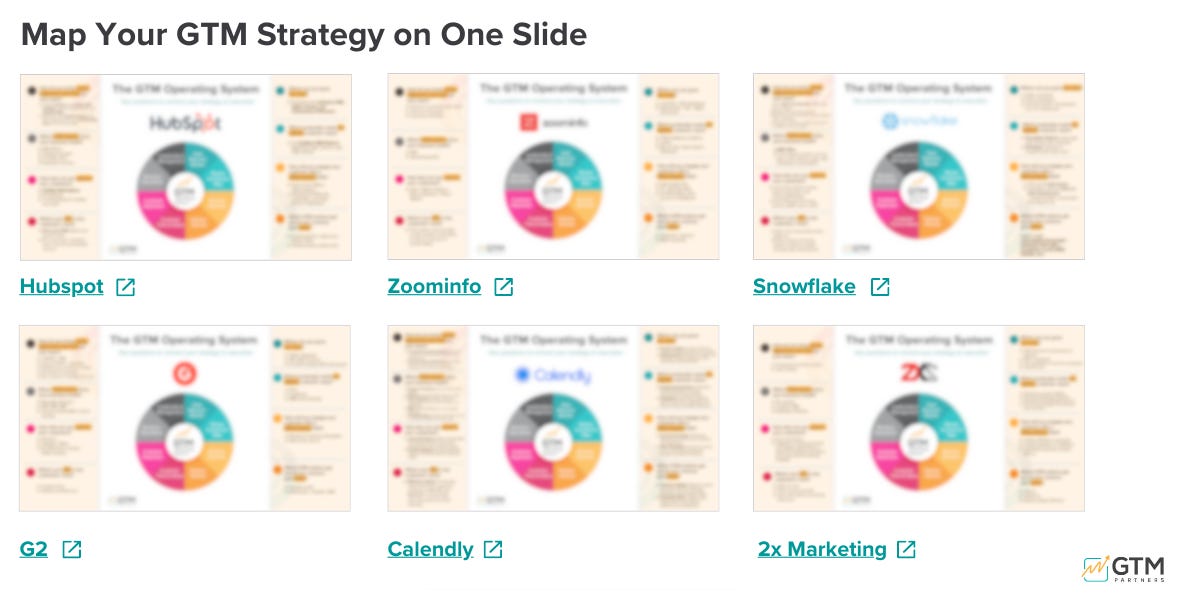
If you cannot put your go to market on a single page, you do not have alignment. You have activity that happens to be busy.
This exercise is uncomfortable for many teams. That discomfort is useful. It exposes missing decisions and fuzzy assumptions that quietly slow execution quarter after quarter.
Step 6. Build your 90 day project list.
Not a twelve month roadmap. Those rarely survive contact with reality.
A focused list of projects that directly address the valley you chose in step one.
Each project should answer one question. What will be materially different by the end of this quarter if we do this?
Just as important, what are you explicitly not doing right now?
That is the full process. Six steps. Every quarter.
This kind of planning is not about perfect answers. It is about disciplined discovery. It is about making tradeoffs explicit before you fund more work. It is about managing complexity as the business grows instead of reacting to it after execution starts to slip.
Why an External GTM Expert Changes the Outcome
Your sales, marketing, product, and customer leaders are too close to the work to see the full system clearly. They own execution. They carry targets. They defend tradeoffs that made sense at the time.
A certified, trained GTM expert from the GTMarketplace brings three things your internal team cannot, no matter how strong they are.
Objectivity: They have no turf to protect and no roadmap to defend. That neutrality surfaces misalignment faster and keeps conversations focused on decisions, not politics.
Pattern recognition: They have seen the same GTM problems across dozens of companies and stages. That experience helps your team distinguish between normal growing pains and real structural issues worth fixing now.
Disciplined cadence: They know how to run this process efficiently, keep it uncomfortable in the right ways, and turn messy dialogue into clear 90-day priorities without overproducing or stalling.
You do not bring in a GTM expert because your leaders are weak.
You bring one in because alignment at this level is too important to leave to chance.
We have 70+ GTM OS Certified Partners, who can run this process at least twice a year. If you are scaling quickly, run it quarterly.
Certified Partner Spotlight: Maria Scheifler, MKT Velocity
Global GTM Planning & Execution for $5M–$150M B2B Companies or Business Units Operating Across Multiple Regions.
Great strategy breaks down fast when companies can’t execute. It breaks even faster when they scale into new markets without a clear global GTM operating model, driving higher CAC, longer sales cycles, and wasted spend.
A GTM Operating System™ Certified Partner and former VP of Global Marketing, with over 15 years of experience, Maria Scheifler helps B2B executive teams and regional or business-unit leaders fix GTM misalignment and execute with clarity as they expand internationally.
Where MKT Velocity Delivers Impact:
GTM Planning Workshop: Aligns CEOs and GTM leaders on priorities and produces a clear 90-day execution plan for single or multi-market growth•
Fractional Global Marketing Leadership: Operationalize strategy, accelerate pipeline, and strengthen execution discipline across teams, regions, and partner ecosystems
ICP, Positioning & Messaging:Sharpens differentiation, defines high-fit segments, and focuses localized demand generation where it matters most.
Maria blends strategic clarity with hands-on operational systems that help companies with global customers execute with speed, stay aligned as they scale, and drive measurable revenue growth.
Learn more: Maria Scheifler Partner Page →
If you’d like to be a certified GTM Partner like Maria and more than 70 others, we’d love to talk to you about how to make that happen.
GTM Events
A list of upcoming events of interest to GTM professionals
January 22, 2026: The 15 GTM Problems Every Company Faces, live in Denver, Colorado (led by GTM certified partners Maria Scheifler, Caitlin Clark-Zigmond, and Newell Faulkinburg)
January 23, 2026: Creating Boundaries for GTM Leaders (led by GTM certified partner Sarah Allen-Short)
February 9, 2026: How to Break Into Startups as a Fractional CRO or GTM Leader (led by GTM Certified Partner Marc Sabatini)
Love,
Sangram and Bryan
p.s. Access GTM University | Hire GTM OS Certified Partners | Read Fractional Friday
Thanks for reading GTMonday by GTM Partners!
Subscribe for free to receive new posts and support our research work.